
-
-
Patient access and cost barriers in the U.S. healthcare system
Patients, employers and policymakers are demanding information about the drivers of healthcare costs from hospitals, insurers, providers and drug manufacturers. Johnson & Johnson has played a leading role in advancing value, patient access and innovation, and has worked to advance transparency in the U.S. healthcare system.
The data tells a clear story:
Net drug prices are down. Patient costs are not.1
In 2025,
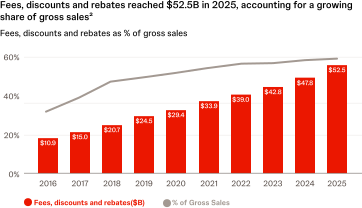
Johnson & Johnson Innovative Medicine provided 59.1% of products’ list prices to healthcare intermediaries, such as insurance companies and pharmacy benefit managers (PBMs), through fees, discounts and rebates, compared to 35.2% in 2016.2 Johnson & Johnson Innovative Medicine invested over $103 billion since 2016 in research and development to deliver breakthrough treatments across some of the most serious diseases.2 But patients continue to face rising out-of-pocket costs and growing barriers to care.
By the numbers
$52.5B
In 2025, Johnson & Johnson Innovative Medicine provided $52.5B in fees, discounts and rebates.2
$11.8B
Our total research and development (R&D) investment for 2025, bringing Johnson & Johnson Innovative Medicine R&D investment to over $103B since 2016.2
59.1%
In 2025, 59.1% of Johnson & Johnson Innovative Medicine products’ list prices went to healthcare intermediaries, such as insurance companies and PBMs.2
-
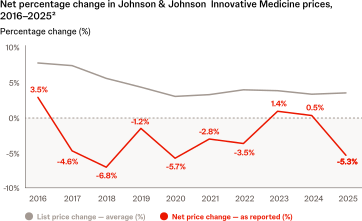
Our average net prices have declined a compounded 22.5% since 20162
The changes in our net prices are much lower than overall inflation growth and changes in our list price.2, 3 -
-
-
Fees, discounts and rebates totaled $52.5B in 20252
Our fees, discounts and rebates paid to intermediaries continued to grow. Since 2016, they have not only increased by absolute dollars, but have increased as a proportion of sales.
-
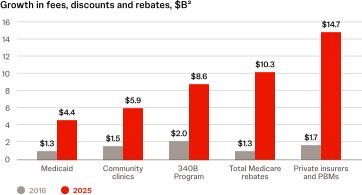
Much of this growth has gone to private insurers and PBMs
Nearly half of our fees, discounts and rebates go to covered entities in the 340B Program, private health insurers and PBMs. Fees, discounts and rebates have risen significantly since 2016. -
Patients should have affordable access to scientific advancements and medical breakthroughs. While the rate of uninsured patients has dropped from 9.7% in 2020 to 8.2% in 2024, three troubling trends are undermining affordable access to innovative medicines.4

People with chronic diseases are being left behind
Even with insurance coverage, patients with chronic conditions face higher out-of-pocket costs, which limit or reduce access. The Medicare Part D redesign capped annual out-of-pocket costs beginning in 2025, but it left a gap: many treatments for cancer are covered under Part B, where beneficiary coinsurance has no annual limit for those without supplemental coverage.5, 6

Prior authorization and utilization management create barriers to care and administrative burden
Utilization management requirements have become substantial obstacles to timely patient care. Medical practices complete an average of 39 prior authorization requests per physician per week, with physicians and office staff spending 13 hours weekly on these requests.7

Pharmacy Benefit Managers are growing in power
Fees tied to list price can create perverse incentives for PBMs to favor higher list price products. Moreover, PBMs’ vertically integrated business model enables self-preferencing arrangements that interfere with patients’ timely access to affordable medicine, often raising out-of-pocket costs for patients paying based on list price.8
Policy solutions
Implementing policies that expand access, reward high-value care and eliminate barriers like restrictive step therapy and prior authorization is crucial. These actions will reduce unnecessary delays and costs, ensuring patients receive timely and affordable care.
Patient access & cost
- Pass rebates and discounts directly to patients at the point of sale, so lower net prices translate into lower out-of-pocket costs.
- Eliminate patient assistance abuse, including accumulators, maximizers and alternative funding programs (AFPs) that artificially exclude medicines from plan coverage in order to access manufacturer assistance for uninsured patients or foreign suppliers.
- Reform the 340B Program to support its original intent of ensuring affordable access for vulnerable patients.
- Add a requirement in the 340B Program that the manufacturer-provided discounts are used to reduce patient out-of-pocket costs for medicines.
- Reform prior authorization and step therapy to minimize burden, delays in care and ensure clinical rigor.
Accountability & transparency
- Reform PBM incentives to recognize clinical benefit to the patient.
- Increase oversight and accountability for vertically integrated PBMs that can distort formulary decisions, restrict patient choice and increase healthcare costs.
- Enact additional federal and state PBM reforms to de-link fees from list prices and ensure patients benefit from rebates and discounts.
- Enact federal legislation to increase transparency and accountability in the 340B Program, as program participants profit by charging a much higher rate for medications than the discounted price they receive.
The bottom line
Creating a sustainable, patient-centric healthcare system requires policies and regulatory structures that make innovation accessible and affordable to patients.
Johnson & Johnson continues to advocate for policies that reward innovation that directly benefits American patients, expands equitable access and delivers affordable care to patients. Transparency has shown us where the system falls short. Fixing it is an urgent priority.
Citations
All citations
- Adam J. Fein, Ph.D. “2025 Gross-to-Net Realities at Eight Top Drugmakers: The Net Pricing Drug Channel Emerges.” Drug Channels Institute. July 21, 2026. https://www.drugchannels.net/2026/07/2025-gross-to-net-realities-at-eight.html. Accessed September 2026.
- Figure according to Johnson & Johnson internal financial accounting. Values may have been rounded.
- U.S. Bureau of Labor Statistics. “Consumer Price Index Historical Tables for U.S. City Average.” Updated August 2026. https://www.bls.gov/regions/mid-atlantic/data/consumerpriceindexhistorical_us_table.htm. Accessed September 2026.
- Centers for Disease Control Prevention National Center for Health Statistics. “U.S. Uninsured Rate Drops by 15% Since 2020.” June 24, 2025. https://www.cdc.gov/nchs/pressroom/releases/20250624.html. Accessed February 2026.
- MedPAC. “Part B Drugs Payment Systems.” November 2025. https://www.medpac.gov/wp-content/uploads/2024/10/MedPAC_Payment_Basics_25_PartB_FINAL_SEC.pdf. Accessed September 2026.
- Centers for Medicare & Medicaid Services. “Final CY 2025 Part D Redesign Program Instructions Fact Sheet.” April 1, 2024. https://www.cms.gov/files/document/fact-sheet-final-cy-2025-part-d-redesign-program-instructions.pdf. Accessed September 2026.
- Tanya Albert Henry. “Fixing prior auth: Nearly 40 prior authorizations a week is way too many.” American Medical Association. April 24, 2025. https://www.ama-assn.org/practice-management/prior-authorization/fixing-prior-auth-nearly-40-prior-authorizations-week-way. Accessed February 2026.
- Meredith Freed, Juliette Cubanski, Elizabeth Williams, and Kaye Pestaina. “What to Know About Pharmacy Benefit Managers (PBMs) and Federal Efforts at Regulation.” KFF. February 9, 2026. https://www.kff.org/other-health/what-to-know-about-pharmacy-benefit-managers-pbms-and-federal-efforts-at-regulation/. Accessed February 2026.