
-
-
America’s intellectual property system: The backbone of patient access to critical medicines
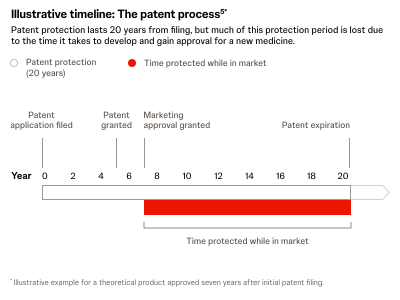
Biopharmaceutical research in the United States is a long and uncertain endeavor, driven by the complexity of hard-to-treat diseases, high development costs and intricate regulatory requirements. Yet patients in the U.S. benefit from biopharmaceutical innovators’ ability to invest billions of dollars into research and development because of the backbone supporting American innovation: the U.S. intellectual property (IP) system.
Without balanced IP rights, innovation falters
Patients enjoy the benefits of competition even before a patent has expired. Even medicines pioneering a new drug class face branded competition within that class after 2.5 years* on average, with a quarter encountering competition within just one year.2 This balanced U.S. IP framework achieves two critical goals: encouraging the development of better treatments while supporting a strong, competitive generic market.
*First-in-class approvals 2005—2011 with later entries through 2015.
Patients benefit both through continued innovation and access to low-cost generics
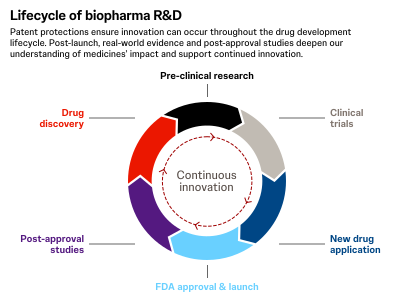
Anything but trivial: Continued innovation
-
 New uses or indications are a form of innovation where drugs are used to treat different conditions than those for which they were initially developed.
 -
 New patient populations can benefit when existing drugs are adapted to address the needs of new subsets of patients.
 -
 New formulations involve modifying how compounds are combined to form the medicine to improve efficacy and address side effects.
 -
 New dosage forms can increase patient adherence and improve outcomes.
Actionable policy solutions
-
Policies to promote American innovation
- Strengthen the balanced IP framework that supports the development of innovative medicines and generic entry.
- Stand against initiatives that erode patent protections.
- Demand transparency and accountability from pharmacy benefit managers in the pharmaceutical supply chain.
-
Policies to promote American competitiveness
- Affirm that robust IP supports competitiveness and improves health outcomes.
- Incorporate IP into trade agreement negotiations and oppose IP waivers.
- Implement robust measures to safeguard emerging technologies from global IP threats.
- Ensure that U.S. trading partners provide IP systems that appropriately protect U.S. innovation.
Citations
All citations
1. Henry Grabowski, Genia Long, Richard Mortimer, and Mehmet Bilginsoy. “Continuing trends in U.S. brand-name and generic drug competition.” Journal of Medical Economics 24, no. 1 (2021): 908-917. DOI: 10.1080/13696998.2021.1952795. Accessed August 2025.
2. Joseph A. DiMasi and R. Chakravarthhy. “Competitive Development in Pharmacologic Classes: Market Entry and the Timing of Development.” Clin Pharmacol Ther. 2016;100(6):754-760. DOI: 10.1002/cpt.502. Accessed November 2025.
3. IQVIA. “Understanding the Use of Medicines in the U.S. 2025: Evolving Standards of Care, Patient Access, and Spending.” April 30, 2025. https://www.iqvia.com/insights/the-iqvia-institute/reports-and-publications/reports/understanding-the-use-of-medicines-in-the-us-2025. Accessed November 2025.
4. U.S. Food and Drug Administration. “Office of Generic Drugs 2022 Annual Report.” March 1, 2023. https://www.fda.gov/drugs/generic-drugs/office-generic-drugs-2022-annual-report. Accessed October 2025.
5. U.S. Food and Drug Administration. “Frequently Asked Questions on Patents and Exclusivity.” February 5, 2020. https://www.fda.gov/drugs/development-approval-process-drugs/frequently-asked-questions-patents-and-exclusivity. Accessed July 2025.
6. Sandra Barbosu. “The Value of Follow-On Biopharma Innovation for Health Outcomes and Economic Growth.” Information Technology & Innovation Foundation. March 2025. https://itif.org/publications/2025/03/17/the-value-of-follow-on-biopharma-innovation/. Accessed June 2025.