
Influence of Prescription Drug Affordability Boards and Upper Payment Limits on state drug pricing
Since 2019, several state prescription drug affordability boards (PDABs) have taken steps toward establishing upper payment limits (UPLs) on prescription drugs. However, UPLs likely will not help states achieve their intended goals and will create new negative consequences, such as reduced access, larger out-of-pocket (OOP) burdens for patients and a reduction in reimbursement for providers. States seeking to implement UPLs should consider the downstream consequences of price setting, as UPLs’ value may be limited—if not detrimental—in the long term.
Our research on PDABs and UPLs
-
2026 report
This research paper examines state use of existing pricing benchmarks, including Medicare’s “Maximum Fair Price” (MFP), international reference prices and other state UPLs. It finds that these approaches may not address underlying affordability challenges and could lead to unintended consequences for patient access, coverage and healthcare system dynamics.
-
2025 update
This research paper offers an analysis of recent state activity and builds upon our initial findings that UPLs are likely to result in unintended consequences and implementation challenges throughout the healthcare ecosystem, ultimately resulting in reduced access and increased costs for patients. -
2024 report
In this first-of-its-kind analysis, we concluded that UPLs will not help states achieve their intended goals of reduced patient out-of-pocket costs and lower state drug spend. Rather, they could create unintended negative consequences, such as reduced access, larger patient out-of-pocket burden and reduced reimbursement for providers.
-
-
Ongoing legislative efforts and Inflation Reduction Act (IRA) implementation
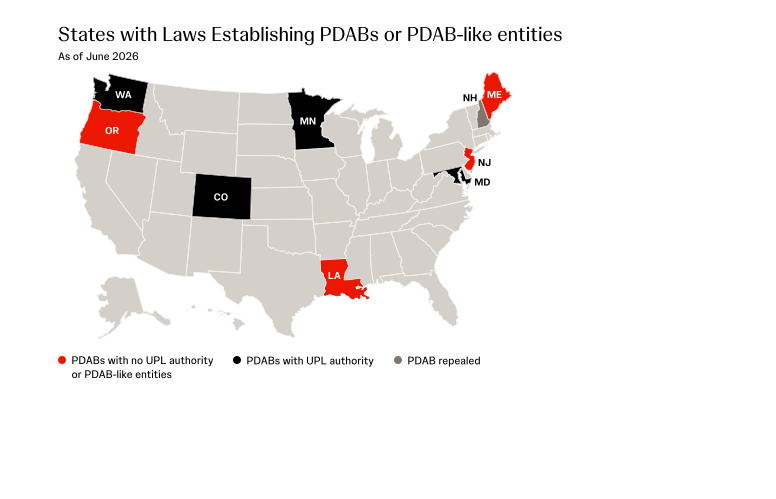
Some state legislatures have established PDABs as a mechanism to conduct drug affordability reviews on specific products.- Maryland created the first state PDAB in 2019.1
- Since then, Colorado, Louisiana, Maine, Minnesota, New Jersey, New Hampshire, Oregon and Washington have created PDABs or similar entities to conduct drug affordability reviews.1,2 However, as of July 1, 2025, the New Hampshire PDAB has been dissolved.3
- Other states have created bodies to study drug costs but have different mandates; for example, Vermont’s Green Mountain Care Board has the option to conduct an affordability review of a set of drugs, but it is not required.4
-
Value is not at the center of PDAB reviews
UPL-setting does not address the role of pharmacy benefit managers (PBMs) and insurers in setting OOP costs for patients, nor does it incorporate the value of the treatments on health outcomes or the healthcare system.5
Unintended consequences of PDABs and UPLs
UPLs are unlikely to improve patient affordability, mostly due to the unintended consequences they are likely to create across the supply chain and the subsequent risks
posed to patient access.
Possible consequences of using existing benchmarks
The adoption of existing benchmarks as payment controls has several downstream consequences for patient access. Whether a state develops and implements its own UPL or uses an existing price benchmark to set a UPL, ecosystem reactions such as utilization management, increased cost sharing or restricted access will likely persist.
Formulary access
UPLs can possibly increase a plan’s net costs even when the capped payment appears comparable to or higher than a plan’s negotiated price. In response, plans may restrict patient access via stricter formulary management or tiering changes.6
Cost sharing
Though some states require payers to pass through any UPL-related savings to patients, it remains uncertain whether such savings will materialize or how this requirement would be implemented and monitored.7, 8, 9, 10 State laws also do not prevent changes to plan tiering or coverage for drugs with payment caps, which could further increase patient OOP costs if drugs are shifted to forumlary tiers with greater cost sharing requirements.
Availability
Payment limits may lower reimbursement for pharmacies and providers without requiring a reduction in acquisition costs, meaning they take a loss.11 As such, pharmacies may choose not to stock and providers may choose not to administer drugs with payment caps applied, preventing patients from accessing their critical medications.12
-
Benefit design and patient access
UPL setting for select drugs may shape payer and PBM decision-making in ways that could work counter to PDABs’ primary intent and increase patient cost sharing or reduce patient access.
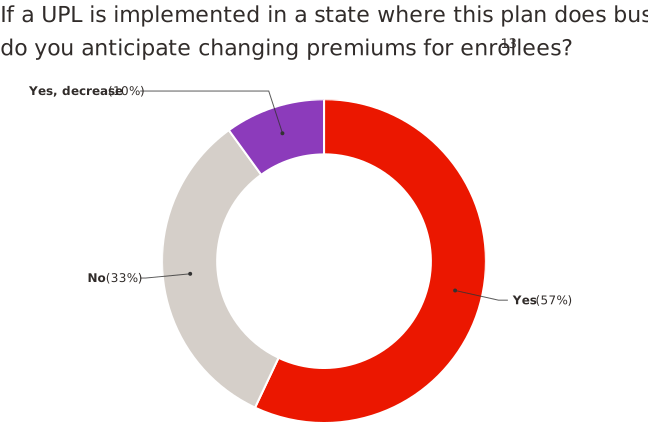
Payers have confirmed they are considering these actions if UPLs are implemented.13 In research conducted in 2024 from Avalere Health and the Partnership to Fight Chronic Disease, when asked about the potential for these benefit design changes, all interviewees agreed that UPL-affected drugs or their competitors in the therapeutic class could see greater UM, depending on how manufacturers respond to supply chain changes, rebating and UPL implementation. In addition, five of six interviewees indicated that they expect formulary adjustments, such as moving selected drugs and therapeutic alternatives to different tiers.14 In a 2025 survey update, 57% of the health plan respondents said they anticipate increasing premiums due to UPL implementation.13 -
A partial list of additional impacts:
Patient choice
As UPLs grow, payers may consider removing themselves from state-regulated markets because of their decreased ability to make a profit.
Provider reimbursement
UPL reimbursement pressures could also prompt providers to change referral, prescribing and acquisition patterns for drugs subject to price setting.15
Community pharmacies
While UPLs set a ceiling for pharmacy reimbursement, they do not establish a minimum threshold, creating the risk that pharmacies could be reimbursed below acquisition cost for certain drugs.16
-
The long-term consequences
Much of PDABs’ efficacy hinges on the ability to produce valuable solutions that work across the drug pricing supply chain and the unproven assumption that cost savings will be passed onto patients. Future negative effects of price setting may include: -
- Alteration of payer and PBM benefit designs across states and markets due to lowered reimbursement for products.
- Changes in both payer and PBM contracting, as well as manufacturer contracting for products, altering provider reimbursement and Medicaid rebates.
- Reductions in manufacturer innovation and research in high-value areas subject to price limits, similar to the effects of the Inflation Reduction Act (IRA).
All citations
Citations
- National Academy for State Health Policy. “Comparison of State Prescription Drug Affordability Review Initiatives.” March 31, 2022. Accessed December 7, 2023. https://nashp.org/comparison-of-state-prescription-drug-affordability-review-initiatives/.
- Louisiana State Legislature. “SB401: PHARMACEUTICALS: Provides for a Prescription Drug Affordability Board.” June 2026. Accessed July 2026. https://www.legis.la.gov/Legis/BillInfo.aspx?i=250961.
- New Hampshire Department of Health& Human Services. “New Hampshire Prescription Drug Affordability Board.” New Hampshire Department of Health& Human Services. July 1, 2025. Accessed August 2025. https://www.dhhs.nh.gov/programs-services/medicaid/new-hampshire-prescription-drug-affordability-board.
- State of Vermont. “Act 134 (2024).” Vermont Legislature. 2024. Accessed July 2025. https://legislature.vermont.gov/Documents/2024/Docs/ACTS/ACT134/ACT134%20As%20Enacted.pdf.
- Kelly Schulz. “In Maryland, Drug Price Controls Won’t Help Patient Affordability.” Maryland Matters. October 26, 2024. Accessed July 2025. https://marylandmatters.org/2024/10/26/in-maryland-drug-price-controls-wont-help-patient-affordability/.
- Aliana Potter, Lisa Joldersma, Tiernan Meyer, Emily Donaldson, and Sofia Toso. “Update: Health Plans’ Perceptions of PDABs and UPLs.” Avalere Health. March 28, 2025. https://advisory.avalerehealth.com/insights/update-health-plans-perceptions-of-pdabs-and-upls.
- State of Minnesota Revisor of Statutes. “Minnesota Statute, 62J.92.” 2025. https://www.revisor.mn.gov/statutes/cite/62J.92.
- Colorado Legislature. “Senate Bill 21-175.” June 16, 2021. https://leg.colorado.gov/bill_files/54957/download.
- Julie A. Patterson, James Motyka, Jonathan D. Campbell, and John Michael O’Brien. “Unanswered Questions And Unintended Consequences Of State Prescription Drug Affordability Boards.” Health Affairs. June 5, 2024. https://www.healthaffairs.org/do/10.1377/forefront.20240603.353747/full/.
- Washington State Legislature. “RCW 70.405.050.” 2022. https://app.leg.wa.gov/RCW/default.aspx?cite=70.405.060.
- Rare Access Action Project. “PDAB Q&A – What You Need to Know.” https://www.rareaccessactionproject.org/wp-content/uploads/2025/07/PDAB-QA.pdf.
- Avalere Health. “Payer Perspectives Confirm UPLs Will Likely Raise Costs and Hinder Patient Access to Medicines.” March 2025. https://b11210f4-9a71-4e4c-a08f-cf43a83bc1df.usrfiles.com/ugd/b11210_1e92735a49744639ac37321c6320e8c8.pdf
- Partnership to Fight Chronic Disease. “Payer Perspectives Confirm UPLs Will Likely Raise Costs and Hinder Patient Access to Medicines.” March 2025. Accessed July 2025. https://b11210f4-9a71-4e4c-a08f-cf43a83bc1df.usrfiles.com/ugd/b11210_1e92735a49744639ac37321c6320e8c8.pdf.
- Luke Frazier and Lisa Joldersma. “Research Explores Health Plan Perceptions of PDABs and UPLs.” Avalere Health. April 2, 2024. Accessed August 2025. https://advisory.avalerehealth.com/insights/research-explores-health-plan-perceptions-of-pdabs-and-upls.
- Ethan Basch, Daniel A. Goldstein, Aaron P. Mitchell, Esita Patel, Daniel Richardson, Jason S. Rotter and Stephanie B. Wheeler, “Association Between Reimbursement Incentives and Physician Practice in Oncology A Systematic Review.” JAMA Network. January 3, 2019. Accessed July 2026. doi:10.1001/jamaoncol.2018.6196.
- The Partnership for Safe Medicines. “How Upper Payment Limits on medicine increase the risk of diverted and counterfeit medicines in the drug supply.” Accessed August 2025. Https://www.safemedicines.org/2024/05/colorado-upls.html.